Empadronamiento in Valencia: Register on the Padrón (2026)
Yes, you have to register: everyone who lives in Spain must be on the padrón of the municipality where they usually live. In València, book a cita previa on valencia.es or by calling 010, bring valid ID and proof of your home, and pay nothing.
Also in: Deutsch
On this page
Found a place to live in València? Register at the Ajuntament de València (Ayuntamiento de Valencia) as soon as you have the address. The SIP health registration and a TIE address change both ask for it.
Do you have to register?
Yes. Everyone who lives in Spain, foreigners included, must register on the padrón of the municipality where they usually live. If you live in several municipalities, register in the one where you spend most of the year. The València procedure covers people arriving from another municipality or from abroad.
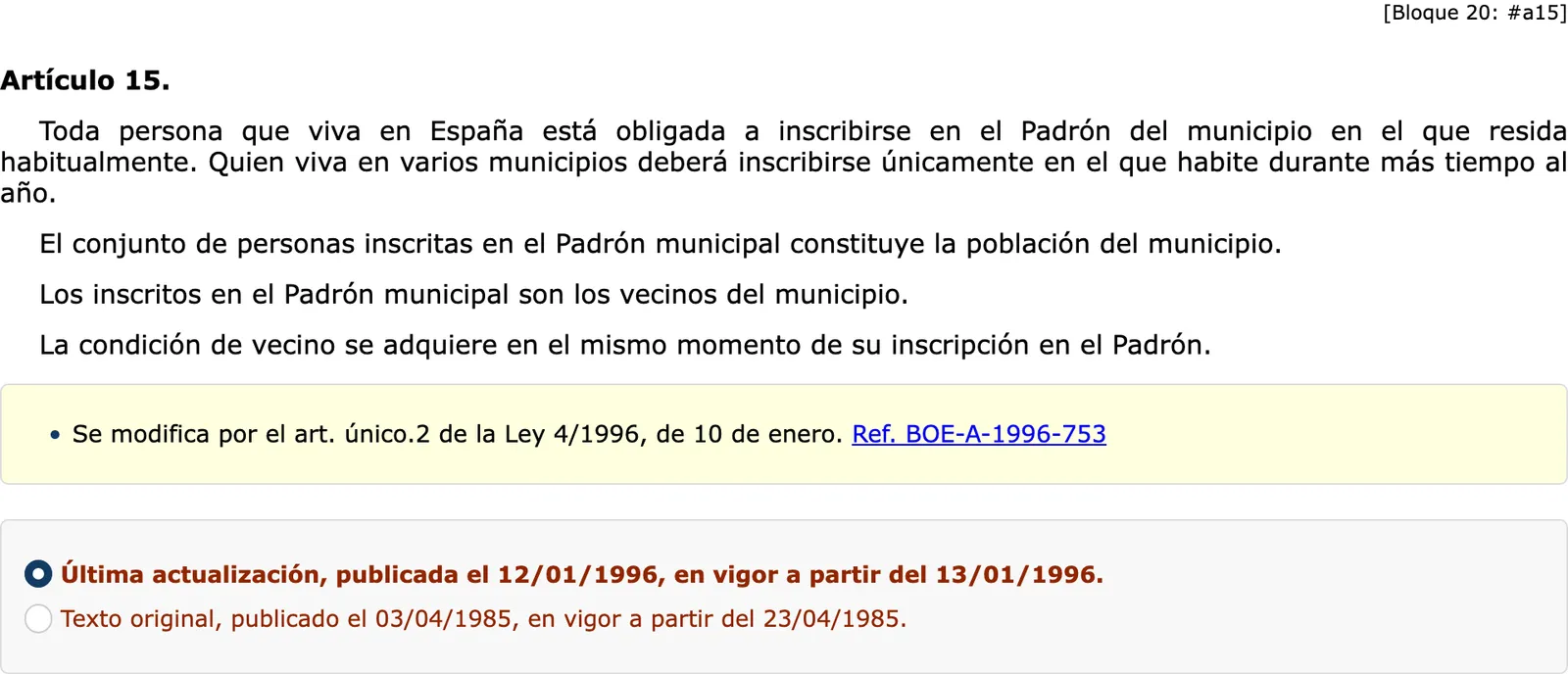
Toda persona que viva en España está obligada a inscribirse en el Padrón del municipio en el que resida habitualmente.
Every person who lives in Spain is obliged to register in the Padrón of the municipality where they habitually reside.
BOE · Ley 7/1985, art. 15 párr. 1
You must be an adult or an emancipated minor to apply for yourself. Children register through their parents (see the documents below).
What the padrón is not
The padrón is not a residence permit. Registration does not prove legal residence in Spain and gives a foreigner no right the law does not already give.
Giving false mandatory data when you register is a serious infringement under the Foreigners Law, unless it amounts to a crime. Serious infringements carry a fine of 501 up to €10,000.
What you need to register
Pack three things: valid ID, proof that you live in the home, and the cadastral reference of that home. The town hall may ask for extra documents to check your identity or your use of the home.
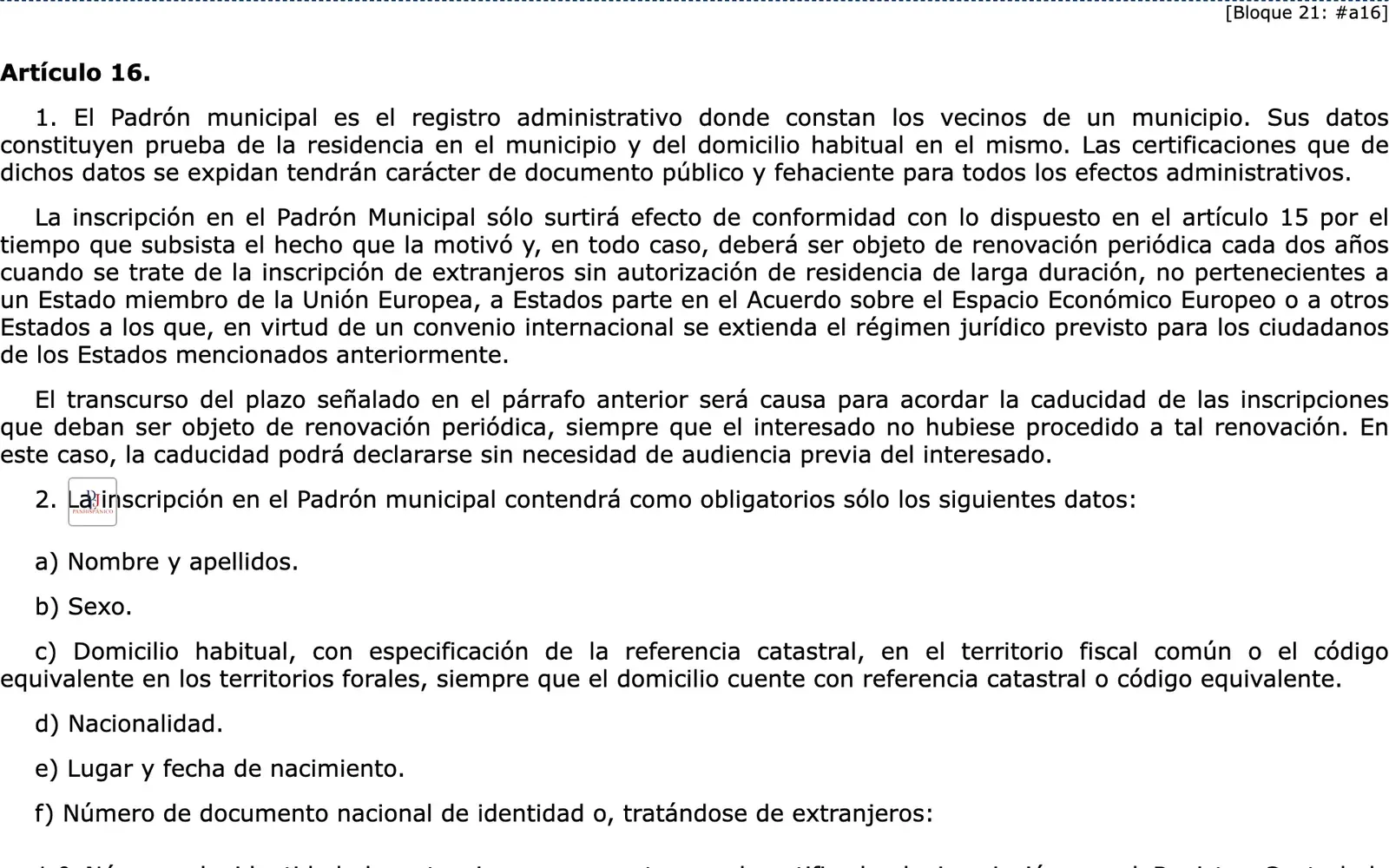
The padrón entry must show your habitual address with its cadastral reference whenever the home has one. The mandatory data are your name and surnames, sex, nationality, place and date of birth, identity document number and any school or academic title you hold.
Identity documents
- Non-EU nationals (and British nationals): residence card or passport.
- EU, Iceland, Liechtenstein, Norway and Swiss citizens: residence card, passport or national ID document.
- Every identity document must be in force.
Documents in Spanish or Valencian are accepted as they are. Otherwise bring the original plus a translation by a sworn translator or a public administration. A foreign public document needs legalisation or an apostille, except documents from EU Member States.
Take originals to an in-person appointment. Documents with crossings-out, smudges or correction fluid are not valid. A printed and scanned copy of an electronically signed document is not valid unless it carries a secure verification code.
Proof of your home
Your proof depends on your situation; pick yours below.
If your document does not show the cadastral reference, add the latest IBI receipt, a recent cadastre report or an up-to-date land-registry note.
If you own the home
Bring a deed or complete simple copy naming you as owner. If you are named as owner on the IBI receipt, you give no proof, because the town hall checks it itself.
If you rent the whole home
Bring a lease in force, signed by everyone named in it, with a duration of more than six months. Add the latest rent receipt or bank transfer, paid in the last two months. Leases renewed month to month do not prove more than six months.
If you rent a room
The lease must state the total number of rooms in the home and the number of the room you rent. The same six-month and rent-receipt rules apply.
If you live in someone else’s home
Bring the owner’s signed authorisation and the owner’s ID, on the official form. In a rented home that is not yours, you need the signed authorisation and ID of the tenant and of the owner. With several owners, bring authorisations from at least the majority of them.
Signed authorisations are valid for one month from the date on the document.
If your lease may block registration
The town hall may ask for more proof of use of the home, for example for leases with clauses that bar registering extra people, tourist contracts or non-habitual-residence contracts. Tip: ask the landlord for a lease that allows the registration before you sign.
If you have no lease longer than six months
Only a lease of more than six months, in force and with a recent rent receipt, counts as lease proof. Month-to-month renewals do not prove more than six months. Tourist contracts and non-habitual-residence contracts can bring a request for more proof of use of the home.
Ask the owner, or the tenant of a rented home, for a signed authorisation and ID on the official form. In a hotel or other collective establishment that appears as such in the València padrón, bring the signed authorisation of the person in charge, with the institution’s stamp.
Sign a lease of more than six months before the appointment if you can, and keep the first rent receipt.
If you register a child
Bring the family book or birth certificate to prove the parents’ legal representation. If only one parent applies for a child who lives with both, the other parent’s authorisation (Modelo 1) is needed.
Appointment or online: which route?
Both work. To go in person, book a cita previa on valencia.es or call 010, 963100010 or 962081104. You get one appointment per person unless you are a family unit.

- Book the appointment on the city website or by phone.
- Go to the office with the originals of your identity and home documents.
- Or file online with electronic identification and signature. The request is not instant, because the town hall reviews the documents first.
- Do not file again after an online request unless you notice that documents are missing.
- Print and keep the filing receipt, then follow the request and add documents in the citizen folder (Carpeta Ciudadana) of the sede.
The town hall has up to 3 months to resolve the registration. If it does not resolve it in that time, silence counts as approval, provided the essential requirements are met. All padrón procedures in València are free.
Which office to use
The Padrón office sits on Plaza del Ayuntamiento, with its entrance on Periodista Azzati, 2, open Monday to Friday 8:30 to 14.00.

Placa de l'Ajuntament 1 (padron office entrance: C/ Periodista Azzati 2), 46002 Valencia, Spain · Open in Google Maps (opens in a new tab)
Other offices take padrón appointments in the same hours, Monday to Friday 8.30 to 14.00:
- Russafa (Ruzafa in Spanish) district office, C/ Maties Perelló, 5.
- Patraix district office, Calle Beato Nicolás Factor, 1.
- Marítim district office, C/ Barraca, 53.
- Abastos district office, C/ Alberic, 18.
- Trànsits district office, C/ Comte de Lumiares, 5.
- Exposició district office, Calle Guàrdia Civil, 19.
The citizen service office OAC Tabacalera, C/ Amadeu de Savoia, 11, 46010 València, also handles padrón. Pobles del Nord handles it on Mondays and Wednesdays 8:30 to 14:00. Pobles del Sud handles it on Tuesdays and Thursdays 8.30 to 14.00.
Carrer d'Amadeu de Savoia, 11, El Pla del Real, 46010 Valencia, Spain · Open in Google Maps (opens in a new tab)
Carrer de Matias Perello, 5, L'Eixample, 46005 Valencia, Spain · Open in Google Maps (opens in a new tab)
C/ del Beat Nicolau Factor, 1, Patraix, 46007 Valencia, Spain · Open in Google Maps (opens in a new tab)
If one office has no free slot, check another, because all of them take padrón appointments.
How do you get your padrón certificate?
Ask for the certificate straight after registering. It proves you are registered and justifies your address and residence before other bodies. Its certifications are public documents for all administrative purposes.

Three types matter to a newcomer:
- Individual: proves your registration at the moment of the request.
- Individual historical: proves your registration date and later movements.
- Dwelling: also states how many people are registered at the address, for family reunification or an invitation letter.
Ask for it in one of three ways:
- Online, with a Generalitat Valenciana digital certificate or an electronic DNI.
- By phone on 010, with delivery by post or email.
- In person at the padrón offices, with an optional cita previa.
You can request your own certificate, or someone you authorise can. The 010 line runs Monday to Friday 8:30 to 18:30 and Saturday 9:00 to 14:00. From outside València call 96 310 00 10.
Does the padrón expire?
Yes, for non-EU foreigners without a long-term residence authorisation: renew the registration every two years.
deberá ser objeto de renovación periódica cada dos años cuando se trate de la inscripción de extranjeros sin autorización de residencia de larga duración
It must be renewed periodically every two years in the case of registration of foreigners without a long-term residence authorisation.
BOE · Ley 7/1985, art. 16.1 párr. 2
If you miss the renewal, the town hall may declare the registration lapsed. It may do so without hearing you first. A TIE holder who changes address asks the police station for a duplicate card and brings the current padrón certificate.
| Infringement under the Foreigners Law | Fine |
|---|---|
| Minor | up to 500 euros |
| Serious (includes false padrón data) | 501 to €10,000 |
What comes after the padrón?
The certificate opens the steps that ask for it.

- Health: SIP registration needs habitual residence in a municipality of the Comunitat Valenciana, which requires being on its padrón. With private insurance, the certificate is not mandatory. See SIP card in Valencia.
- Residence card: a visa or authorisation for more than six months means you apply for the TIE in person. Do it within one month of entry or of the grant taking effect. See TIE card in Valencia and NIE vs TIE.
- EU citizen: apply for the EU registration certificate within three months of entering Spain. See the moving checklist and the S1 guide for EU pensioners.
- Appointments for foreigners: the police stations and the Oficina de Extranjería run separate systems, covered in cita previa for extranjería in Valencia.
- Driving: a foreign non-EU licence stays valid for at most six months from the day you acquire normal residence. You can exchange it as soon as you have normal residence. See exchange your driving licence.

Need a lease that allows registration? Read rent an apartment in Valencia, or browse the admin guides hub.
Photo credits
- Plaza del Ayuntamiento, the square in front of the town hall: Zarateman, Wikimedia Commons (opens in a new tab) (CC0)
- The fountain side of Plaza del Ayuntamiento, central Valencia: Julian Monrabal, Wikimedia Commons (opens in a new tab) (CC0)
- Photos and clips uploaded to Google Maps (OAC Tabacalera, Valencia on Google Maps (opens in a new tab), Valencia City Hall on Google Maps (opens in a new tab)) by J. Ignacio del Saz, july sansano climent, Paulina Cuevas, Armino.
Not confirmed: Whether registration gives you the certificate the same day: they are separate procedures, so ask for it straight after. Whether a lease of six months or less is accepted alone: ask at the cita previa.
Reach readers planning life in Valencia. Advertise → hello@settlevalencia.com
Common questions
Is empadronamiento free in Valencia?
Yes. All padrón procedures at the Ajuntament de València are free. Bring the originals of your documents to an in-person appointment. Documents that are not in Spanish or Valencian need the original plus a translation by a sworn translator or a public administration.
How long does the registration take?
Up to 3 months: the town hall has that long to resolve a registration. If it does not resolve it in that time, silence counts as approval, provided the essential requirements are met. An online request is not instant, because the documents are reviewed first.
Do I need a rental contract to register?
Not necessarily, but you need proof that you live in the home, and a lease is one way. A valid lease longer than six months with a rent receipt from the last two months works. In someone else's home, bring the owner's signed authorisation and ID.
Can I register online?
Yes, if you can identify yourself and sign electronically under the sede's signature systems. The town hall reviews your documents first. You then follow the request and add missing documents in the citizen folder of the sede.
Do I need an NIE to register?
Not necessarily. Non-EU nationals show a residence card or passport. For a non-EU national the padrón records the NIE shown on a valid Spanish document or, if they have none, the number of their valid passport.
Will my padrón registration expire?
For non-EU foreigners without a long-term residence authorisation, registration must be renewed every two years. If it is not renewed, the town hall may declare it lapsed, without first hearing you. EU and EEA nationals are outside that renewal rule.
Does being on the padrón make me a legal resident?
No. Registration does not prove legal residence in Spain and gives a foreigner no right that the law does not already give. It is proof of your habitual address in the municipality, and its certificates count as public documents.
Read next
General information checked against the sources listed above, not legal advice for your situation. Rules and office practice change; confirm with the immigration office or a licensed adviser before you act. See how guides are checked.
Spotted an error? Report it.