Beckham Law in Spain: Who Qualifies and How to Apply
The Beckham law is article 93 of the IRPF law. After five non-resident years, a move for a job, directorship, entrepreneurial activity or highly qualified work lets you opt for non-resident taxation. It lasts for the year you become resident and five more. File Modelo 149 within six months.
Also in: Deutsch
On this page
Got a job offer in Valencia and heard the Beckham law could cut your tax bill? “Beckham law” is the popular name for the special regime in article 93 of Law 35/2006, the IRPF law. Below: who qualifies, how the opt-in form works and where the regime stops. Your personal tax figure is a job for a gestor or asesor fiscal; the last section says when to book one.
Do you qualify?
Check three conditions first, because you need all three, set by article 93.1.
- You were not resident in Spain during the five tax years before the year you move.
- The move happens in the first year the regime applies to you or the year before, and results from one of the four circumstances below.
- You do not earn income that would count as earned through a permanent establishment in Spain, except as an entrepreneur or highly qualified professional.
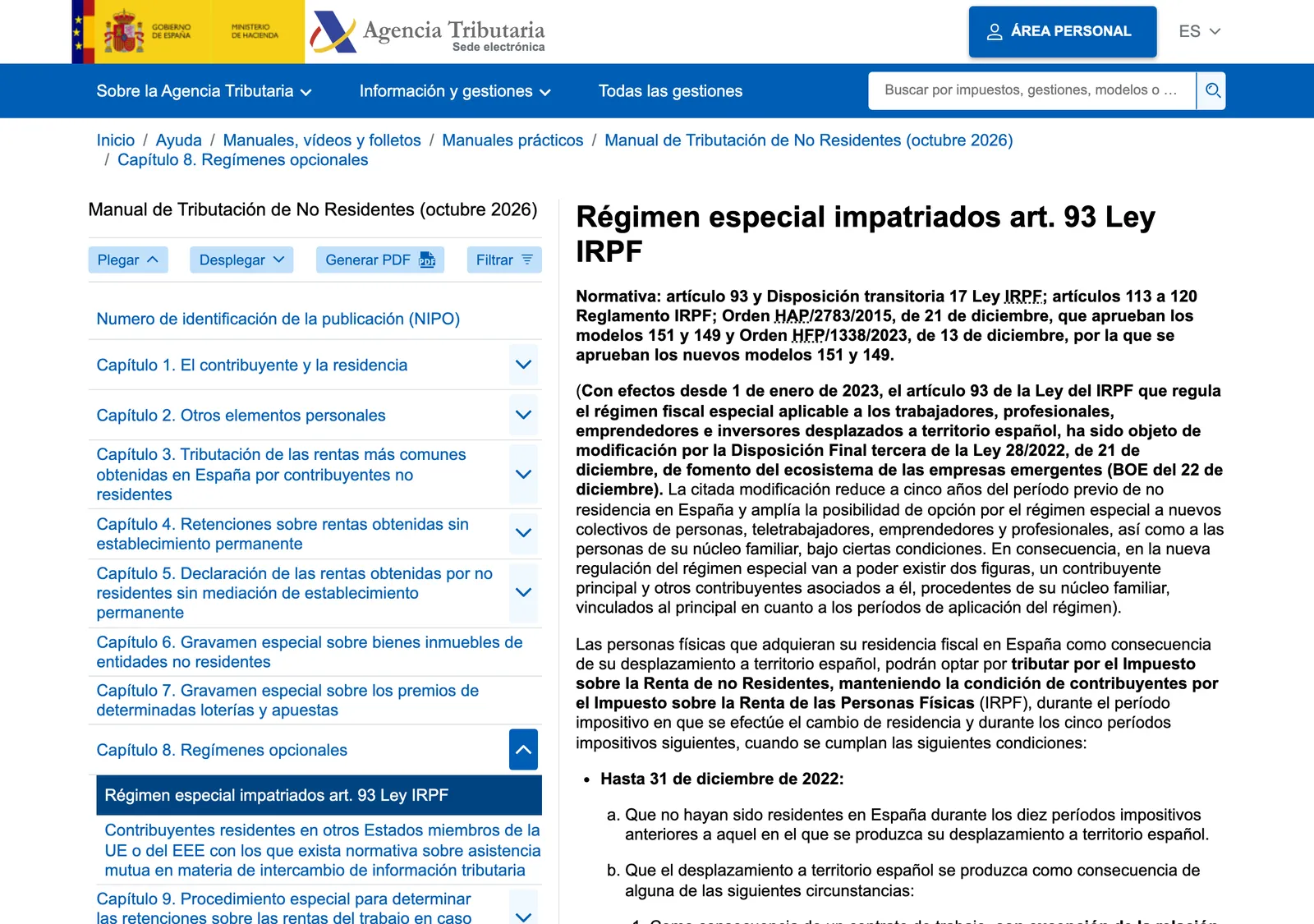
a) Que no hayan sido residentes en España durante los cinco períodos impositivos anteriores a aquél en el que se produzca su desplazamiento a territorio español.
a) That they have not been residents in Spain during the five tax periods prior to the one in which their move to Spanish territory takes place.
BOE · Ley 35/2006, art. 93.1.a)
Until 31 December 2022 the prior-residence test was ten tax years. Law 28/2022 cut it to five and added remote workers, entrepreneurs and family members.
If you move for an employment contract
An employment contract meets the condition, except the special employment relationship of professional athletes. The condition is also met in two more cases.
- Your employer orders the move and issues a secondment letter.
- You work remotely for an employer, using exclusively IT, telematic and telecommunication means, even though the employer did not order the move.
Employees who hold the international teleworking visa meet the condition.
If you become a company director
The second route is becoming a director (administrador) of an entity.
If you start an entrepreneurial activity
The third route is an economic activity classed as entrepreneurial under article 70 of Law 14/2013.
If you are a highly qualified professional
The fourth route is work as a highly qualified professional serving start-ups, or in training, research, development and innovation. That remuneration must be more than 40% of all your business, professional and employment income.
What changes in your tax
You stay an IRPF taxpayer, but the tax is worked out with the non-resident income tax rules, plus the special rules in article 93.2.
Rates
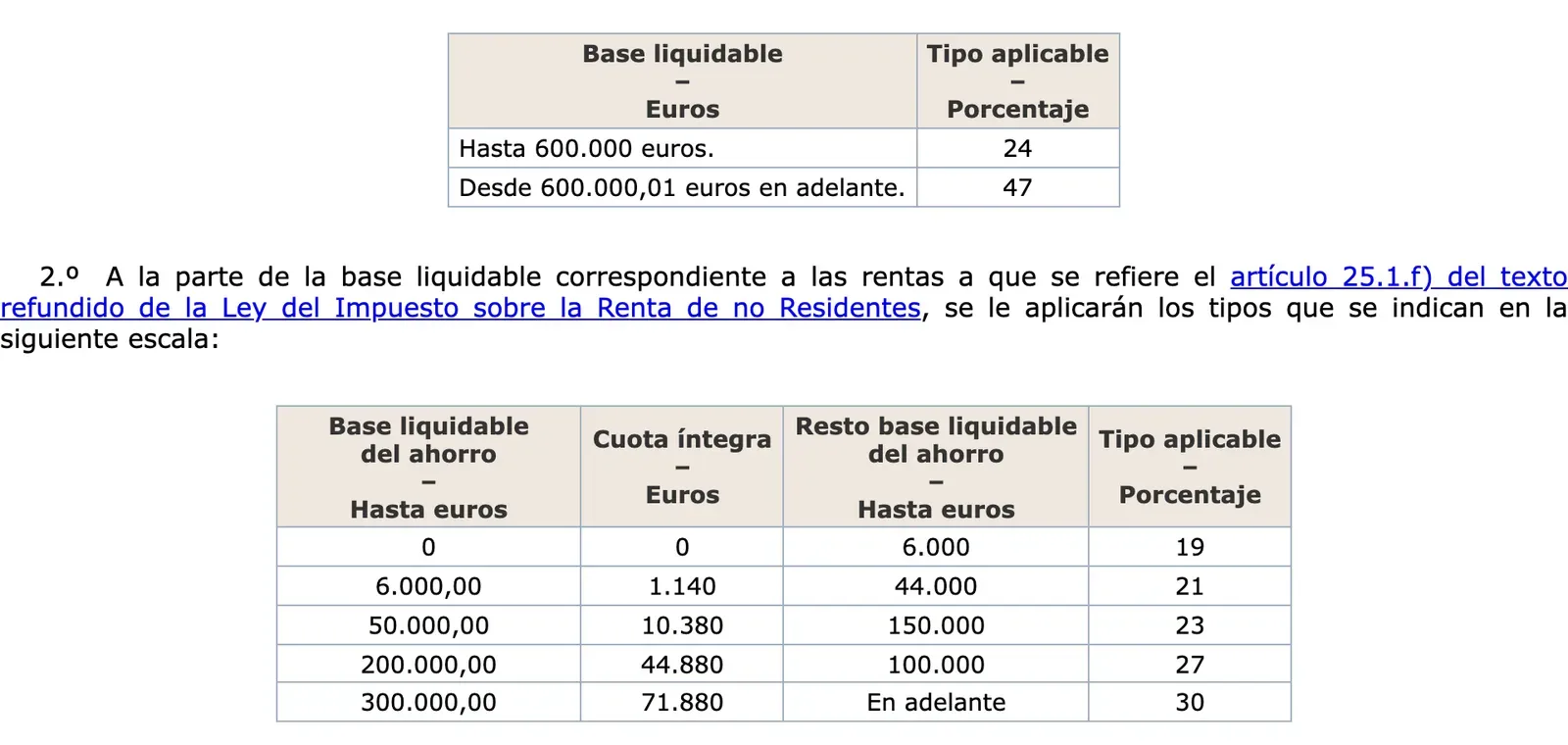
Rates first. Employment income and qualifying entrepreneurial income earned during the regime count as earned in Spain. Spanish-source income is taxed cumulatively, with no offsetting between items.
| Income | Band | Rate |
|---|---|---|
| General (employment, entrepreneurial) | Up to €600,000 | 24% |
| General | From €600,000.01 | 47% |
| Investment-type | Up to €6,000 | 19% |
| Investment-type | Next €44,000 | 21% |
| Investment-type | Next €150,000 | 23% |
| Investment-type | Next €100,000 | 27% |
| Investment-type | Above €300,000 | 30% |
Employers withhold 24% on employment income. Above €600,000 a year from the same payer, they withhold 47% on the excess.
What the regime does not change
- Treaties. You are not treated as a resident for the application of a double taxation treaty, because you are taxed only on Spanish-source income.
- Earlier and later work. Income from an activity done before the move, or after you notify the end of the posting, is not treated as earned during the regime.
- Foreign tax credit. The credit for foreign tax on employment or entrepreneurial income earned abroad is capped at 30% of the part of the gross tax that corresponds to that income.
- Wealth tax. You are taxed only on assets and rights located in Spain.
What you pay if you do not opt in
Compare the ordinary route before you commit. Without the regime you are a resident taxed on worldwide income. Two scales apply to the general taxable base: the state scale and the Comunitat Valenciana scale. The Valencian scale changes from 1 January 2027.
| State scale band | Rate |
|---|---|
| First €12,450.00 | 9.50% |
| Next €7,750.00 | 12.00% |
| Next €15,000.00 | 15.00% |
| Next €24,800.00 | 18.50% |
| Next €240,000.00 | 22.50% |
| Above €300,000.00 | 24.50% |
| Comunitat Valenciana band (2026) | Rate |
|---|---|
| First €12,000 | 8.8% |
| Next €10,000 | 11.7% |
| Next €10,000 | 14.6% |
| Next €10,000 | 17% |
| Next €10,000 | 19.4% |
| Next €10,000 | 21.9% |
| Next €10,000 | 24.4% |
| Next €28,000 | 26.1% |
| Next €50,000 | 27.35% |
| Next €50,000 | 28.35% |
| Above €200,000 | 29.35% |
Worked example: €100,000 of general income
The gap in euros: take a general taxable base of €100,000, with no reductions, deductions or credits. It is a scale-only illustration of the law, not your tax result, and the regional scale result is also reduced for the personal and family minimum.
| Route | Tax on the example base |
|---|---|
| Special regime, 24% | €24,000 |
| Ordinary state scale | €17,950.75 |
| Ordinary Comunitat Valenciana scale | €19,264 |
| Ordinary scales together | €37,214.75 |
On those figures the ordinary scales cost €13,214.75 more. The special regime rate stays at 24% on the part of the base up to €600,000.
Remote employee of a foreign employer
If your employer is abroad and did not order the move, the employment condition is still met when the work is done remotely, using exclusively IT, telematic and telecommunication means. The employer issues a statement recognising the employment relationship, the start date and the estimated duration of the work in Spain. Give the tax office certificate to those obliged to withhold.
Can your family join?

Yes. Your spouse, your children under 25 (any age if disabled) or, without marriage, the children’s other parent may opt in under the same conditions. They must move to Spain with you, or later but before your first tax year under the regime has ended, and acquire Spanish tax residence.
The sum of their taxable bases in each year must be lower than your taxable base. Each person opts individually, and your Modelo 149 is filed before theirs. Their deadline is six months from entering Spain, or yours if that is later.
How to opt in with Modelo 149
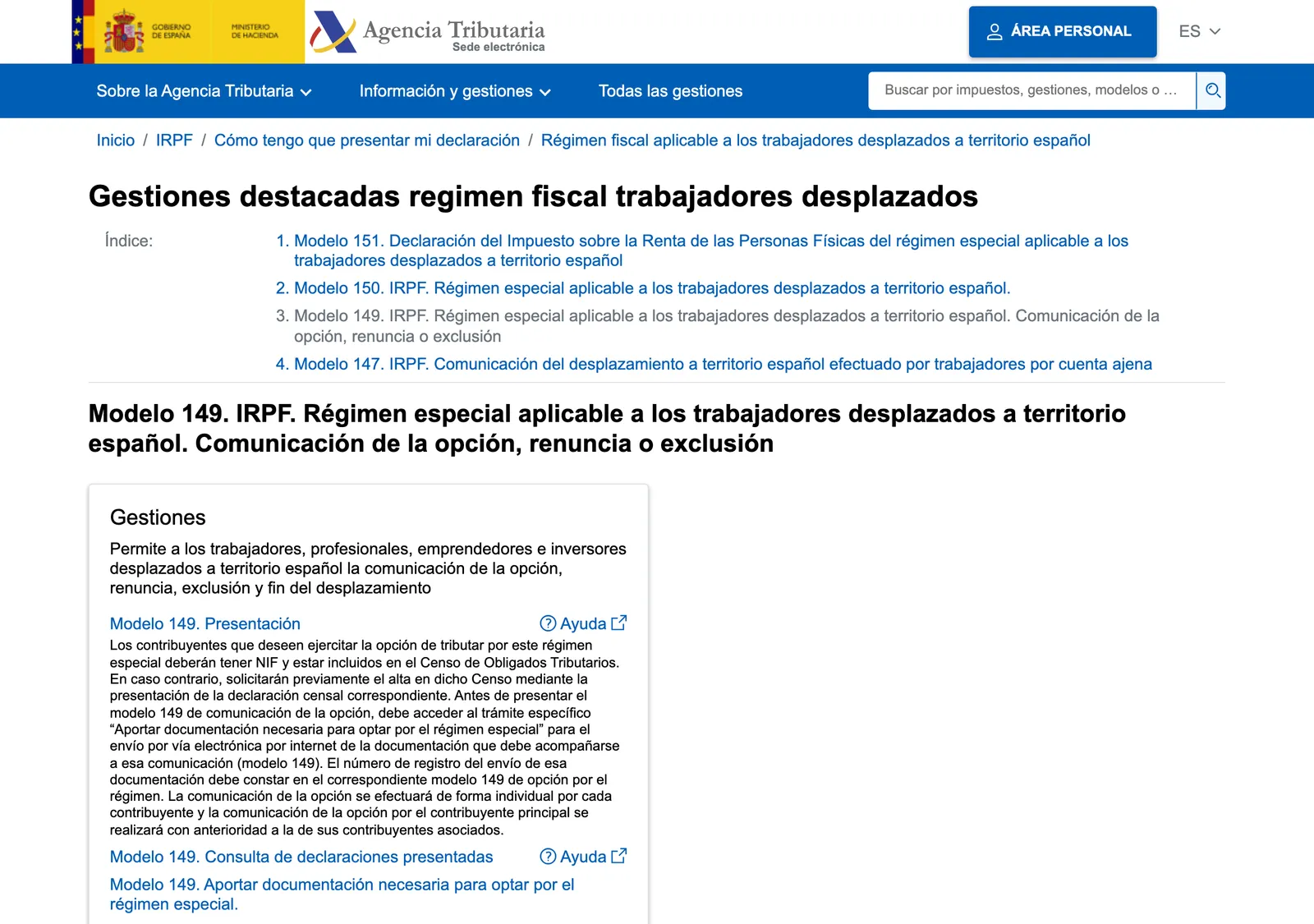
Modelo 149 is the form for opting in, waiving and notifying the end of a posting, and filing is online only, so there is no queue.
- Get a NIF and make sure you are in the Censo de Obligados Tributarios. If you are not, file the censal declaration first.
- Take the activity start date from your Spanish Social Security registration. Six months from that date is your deadline.
- Collect proof of that registration, any residence authorisation, and the documents for your case. Remote workers need an employer statement recognising the employment relationship, the start date and the estimated duration of the work. A new job with a Spanish employer needs a statement with the start date, workplace and contract duration.
- Send the documents through the online step “Aportar documentación necesaria para optar por el régimen especial” before you file.
- File Modelo 149.
- Wait for the certificate. The tax office issues it within ten working days, if the option applies. Give it to your employer as proof that you are under the regime.
a) En el caso del contribuyente a que se refiere el apartado 1 del artículo 93 de la Ley del Impuesto, en el plazo máximo de seis meses desde la fecha de inicio de la actividad que conste en el alta en la Seguridad Social en España o en la documentación que le permita, en su caso, el mantenimiento de la legislación de Seguridad Social de origen o, en caso de que no fuera obligatoria el alta en la Seguridad Social, en el documento justificativo de la fecha de inicio de la actividad.
a) For the taxpayer referred to in section 1 of article 93 of the Law, within a maximum of six months from the activity start date shown in the registration with Social Security in Spain, or in the documentation that allows the home-country Social Security legislation to be kept, or, where Social Security registration is not compulsory, in the document proving the activity start date.
BOE · Real Decreto 439/2007, art. 116.1.a)
Moves from 16 December 2023 onwards follow this six-month rule. If you used the special withholding procedure in article 89.B of the IRPF Regulation, you cannot opt in.
Staying in the regime and leaving it

The term is fixed. The regime runs for the tax year in which you acquire Spanish tax residence and the five tax years after it. That first year is the first calendar year after the move in which you stay in Spain more than 183 days. The 183-day test is explained in the tax residency guide.
- Annual return. You file the special IRPF return, Modelo 151, instead of the usual form. The filing period is the same as the general IRPF return.
- Waiver. Waive in November or December before the calendar year in which the waiver takes effect, using Modelo 149. Nobody who waives can opt in again.
- Exclusion. If a condition stops being met, you notify the tax authority within one month on Modelo 149. Nobody who is excluded can opt in again.
- End of the posting. The end of a posting to Spain is notified on Modelo 149 within one month.
Foreign-asset reporting is a separate duty. As an article 93 taxpayer you do not have to file Modelo 720. Family members who are ordinary tax residents may be obliged to. The Modelo 720 guide has the thresholds.
When to hire a gestor or asesor fiscal
Book one before you file Modelo 149, not after: the six-month and one-month clocks are fixed in the regulations.
- You have employment and self-employed income, or income from a country with a treaty with Spain.
- Your spouse or children want to opt in and you need to check the taxable-base condition.
- You want to compare the regime with the ordinary scale for your own figures.
- You own accounts, shares or property abroad (see the Modelo 720 guide).
The Agencia Tributaria delegation for the city sits on Plaça de l’Ajuntament.
Placa de l'Ajuntament 9, 46002 Valencia, Spain · Open in Google Maps (opens in a new tab)

Photo credits
- A Valencia city square, shown for atmosphere: Wikimedia Commons (opens in a new tab), Zarateman (CC0)
- One of Valencia's old city gates, shown for atmosphere: Wikimedia Commons (opens in a new tab), Diego Delso (CC BY-SA 3.0)
- Photos and clips uploaded to Google Maps (Tax Agency office in Valencia on Google Maps (opens in a new tab)) by Mario Alberto Ru.
Step by step
- Check the three conditionsConfirm five years of non-residence, a qualifying reason for the move and no permanent establishment income.
- Get a NIFYou need a NIF and an entry in the Censo de Obligados Tributarios.
- Register and note your start dateThe activity start date in your Spanish Social Security registration starts the six-month clock.
- Upload the supporting documentsSend them through the online step before filing the form.
- File the form onlineFile Modelo 149: the form can only be filed electronically.
- Give the certificate to your employerThe tax office issues it within ten working days, if the option applies; employers use it as proof for withholding.
Not confirmed: Late filing: the rules set a six-month deadline but say nothing about filing after it, so ask a gestor at once. Modelo 720: article 93 taxpayers are listed as not obliged to file; confirm with a gestor. A foreign employer with no Spanish presence: the texts do not say whether it must withhold; ask a gestor.
Reach readers planning life in Valencia. Advertise → hello@settlevalencia.com
Common questions
Is the Beckham law still available?
Yes. It exists as article 93 of Law 35/2006 and applies to people who become tax resident because of a move to Spain. Until 31 December 2022 it asked for ten prior years of non-residence; it now asks for five. It reaches remote workers, entrepreneurs and family members.
Can I use it as a remote worker or freelancer?
Possibly. Remote work meets the employment condition when it is done exclusively with IT, telematic and telecommunication means. Entrepreneurial activity under article 70 of Law 14/2013 and highly qualified professionals have their own routes. Ask a gestor which route fits your work.
What tax rate would I pay under the regime?
24% on general income up to €600,000 and 47% above it. Investment-type income follows a separate scale from 19% to 30%. Employers withhold 24% on employment income. These are the statutory rates, not your personal result.
How long does the regime last?
Six years: it applies in the tax year you acquire Spanish tax residence and the five tax years after it. That first year is the first calendar year after the move in which you stay in Spain more than 183 days. A waiver ends it for good.
How long do I have to file Modelo 149?
Six months. The main taxpayer has six months from the activity start date shown in the Spanish Social Security registration. Family members have six months from entering Spain, or the main taxpayer's deadline if that is later. The form can only be filed online.
Can my spouse and children join the regime?
Yes, if they meet the conditions. A spouse, children under 25 (any age if disabled) or, without marriage, the children's other parent may opt in under the same conditions. The sum of their taxable bases must be lower than the main taxpayer's in each year.
Is my foreign income taxed in Spain under the regime?
No, in general. Taxpayers under the regime are taxed only on income from Spanish sources. Employment income and qualifying entrepreneurial income earned during the regime count as Spanish-source. Work done before the move or after the end of the posting is outside it.
Can I still use the tax treaty with my home country?
Not as a resident. Taxpayers who opt in are not treated as residents for the application of a double taxation treaty. If a treaty matters for your pension or investments, check the treaty text with an asesor fiscal before you opt in.
Read next
General information checked against the sources listed above, not legal advice for your situation. Rules and office practice change; confirm with the immigration office or a licensed adviser before you act. See how guides are checked.
Spotted an error? Report it.