Spain Tax Residency: The 183-Day Rule and Two Other Tests
You are a Spanish tax resident if you stay in Spain more than 183 days in the calendar year. You are also resident if the main centre or base of your activities or economic interests is in Spain. A non-separated spouse and dependent minor children living in Spain create a presumption of residence.
Also in: Deutsch
On this page
Just landed in Valencia and not sure whether the taxman sees you as a resident? Article 9.1 of the IRPF law (Law 35/2006) decides it. It is a separate question from your visa or your TIE card, and it decides how much of your income Spain taxes.
The three tests in article 9.1
One test is enough to settle it, and any one of them makes you resident. The first is the 183-day count.
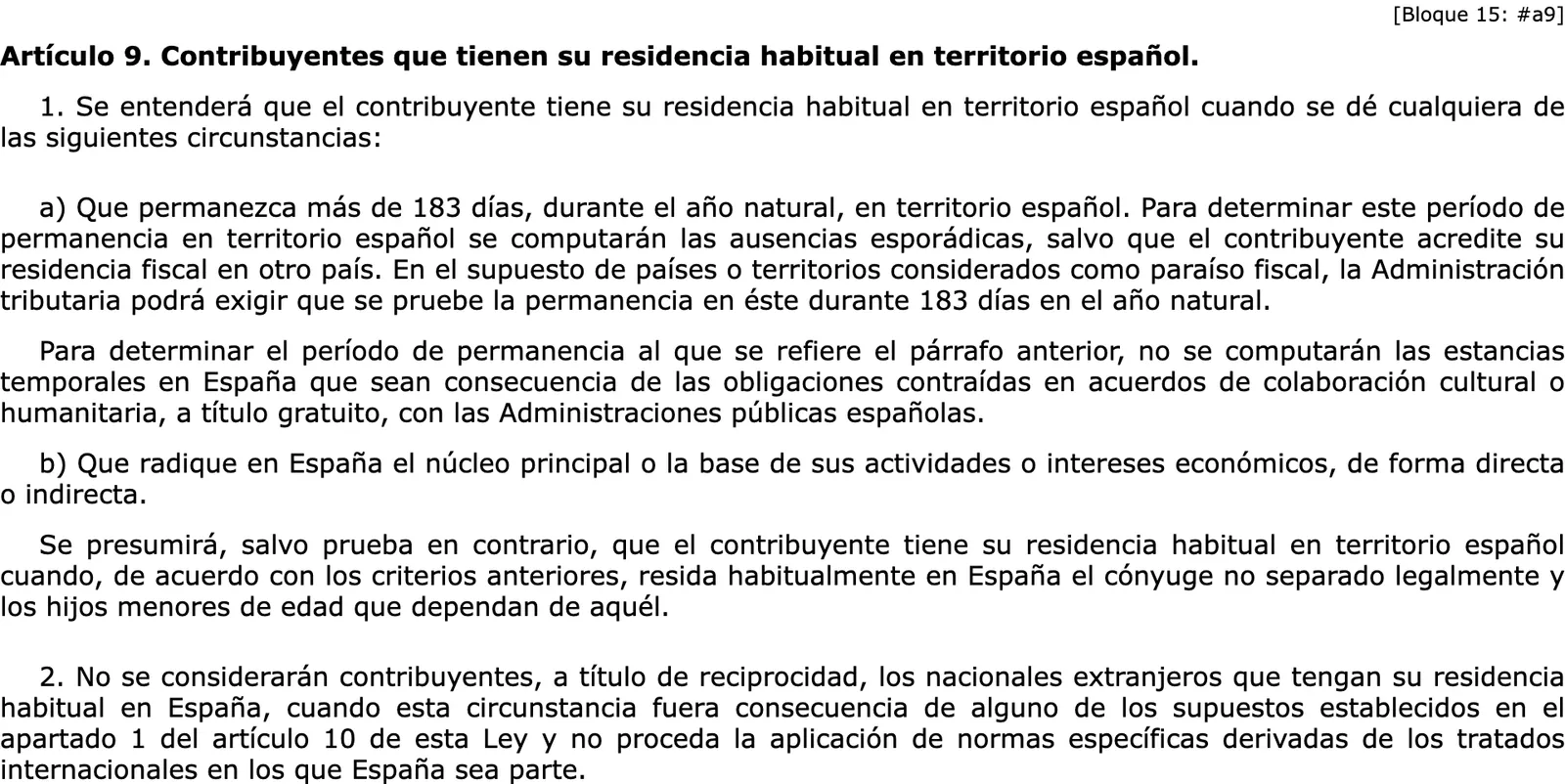
a) Que permanezca más de 183 días, durante el año natural, en territorio español.
a) That they remain more than 183 days, during the calendar year, in Spanish territory.
BOE · Ley 35/2006, art. 9.1.a)
The second test looks at where your life and money are based.
b) Que radique en España el núcleo principal o la base de sus actividades o intereses económicos, de forma directa o indirecta.
b) That the main centre or base of their activities or economic interests is located in Spain, directly or indirectly.
BOE · Ley 35/2006, art. 9.1.b)
If your family lives in Spain
A legally non-separated spouse and dependent minor children who habitually live in Spain make you presumed resident, unless you prove otherwise.
How the 183 days are counted
Count the days you stay in Spanish territory during the calendar year. Sporadic absences stay in the count as days in Spain, unless you prove tax residence in another country.
Two special rules apply.
- Temporary stays in Spain under unpaid cultural or humanitarian cooperation agreements with Spanish public administrations are not counted.
- If you claim residence in a tax haven, the tax authority may require proof of 183 days of presence there in the calendar year.
The result applies to the whole year. You are resident or non-resident for the full calendar year, because a move does not interrupt the tax period.
Tax residence is not your residence permit
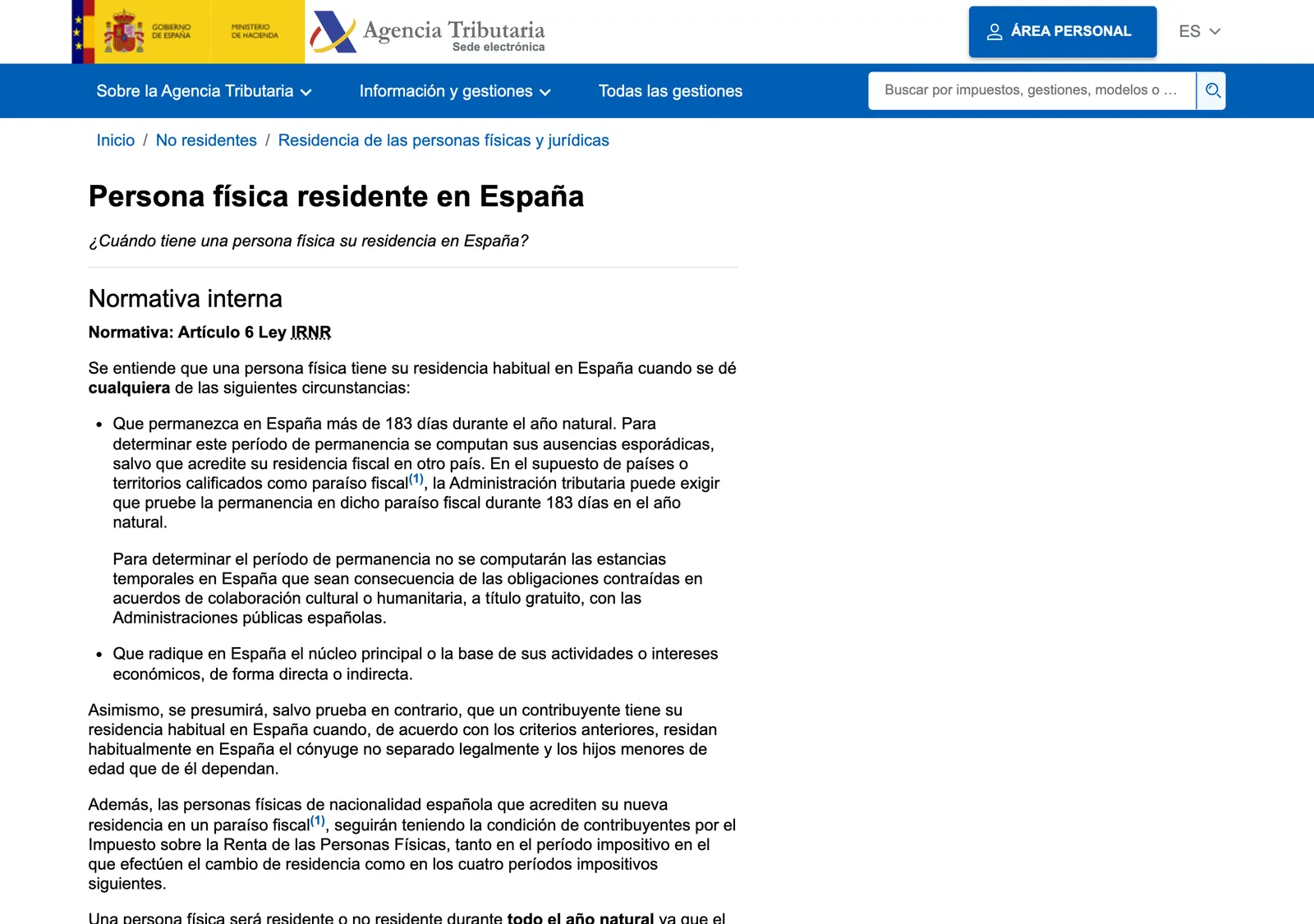
A person can hold a residence permit or administrative residence in a State and not be a tax resident there. Tax residence is decided by the tests in article 9.1, which look at days, economic interests and family.
Treat them as two separate questions. Your permit follows immigration rules. Your tax residence follows the three tests above.

When two countries both claim you
Two countries can both claim you, because Spain’s treaties send each State to its own domestic law to define a resident. The treaties then apply tie-breakers in this order.
- You are resident where you have a permanent home available.
- If you have one in both States, you are resident where your personal and economic ties are closer, the centre of vital interests.
- If that cannot be determined, you are resident where you habitually live.
- If you live habitually in both or in neither, you are resident of the State whose nationality you hold.
To prove residence abroad, get a certificate from the competent tax authority of that country. It is valid for one year.

What changes once you are resident?
A Spanish tax resident is taxed in Spain on worldwide income, subject to the relevant double taxation treaty. Income obtained and taxed abroad gives a deduction of the lower of two amounts set in article 80.1 of the IRPF law.
- Self-employed people registered in the Special Regime for Self-Employed Workers at any point in the year must file an IRPF return.
- Residents are among those obliged to file Modelo 720 on foreign assets. The Modelo 720 guide has the thresholds.
- Newcomers who qualify can opt for the special regime in the Beckham law guide.
Days close to the line, a home or family abroad, or a treaty in play: that is when to book a gestor or asesor fiscal. The Agencia Tributaria delegation for the city sits on Plaça de l’Ajuntament.
Placa de l'Ajuntament 9, 46002 Valencia, Spain · Open in Google Maps (opens in a new tab)
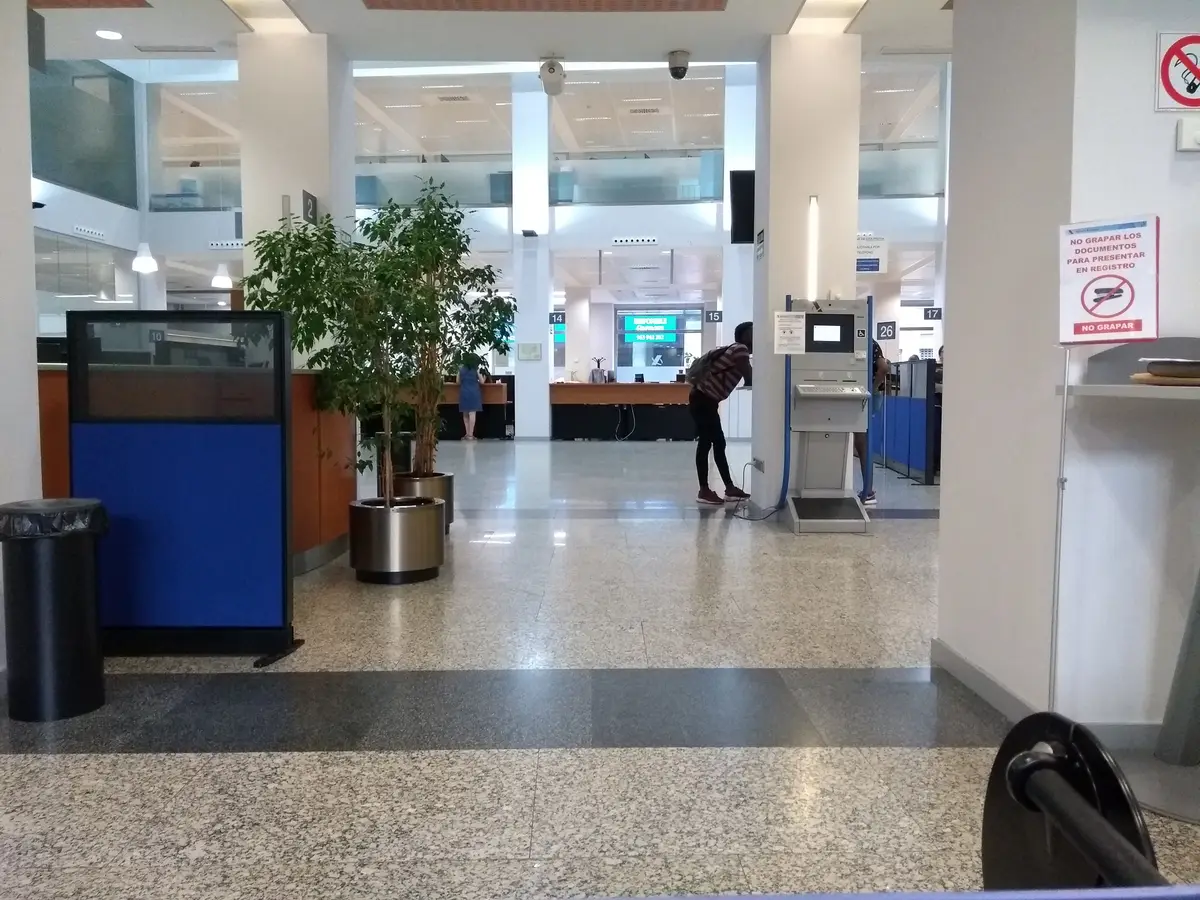
Photo credits
- A Valencia city square, shown for atmosphere: Wikimedia Commons (opens in a new tab), Julian Monrabal (CC0)
- A modern landmark in Valencia, shown for atmosphere: Wikimedia Commons (opens in a new tab), Diego Delso (CC BY-SA 3.0)
- Photos and clips uploaded to Google Maps (Tax Agency office in Valencia on Google Maps (opens in a new tab)) by Guillem G..
Not confirmed: Arrival and departure days: the article 9.1 text gives no rule for part-days. Ask an asesor fiscal to confirm your count when it is close to 183.
Reach readers planning life in Valencia. Advertise → hello@settlevalencia.com
Common questions
Do the 183 days have to be in a row?
No. The test counts days of stay during the calendar year, and sporadic absences are added to the days in Spain unless you prove tax residence in another country. Ask an asesor fiscal how arrival and departure days are counted if your total is close to the line.
Can I be a tax resident with fewer than 183 days?
Yes. Spain also treats you as resident when the main centre or base of your activities or economic interests is in Spain, directly or indirectly. A legally non-separated spouse and dependent minor children who habitually live in Spain create a presumption of residence, unless proven otherwise.
Does my residence permit make me a tax resident?
No, not by itself. A person can hold a residence permit or administrative residence in a State and not be considered a tax resident there. Tax residence follows the tests in the IRPF law, not the card in your wallet.
Do trips abroad reduce my 183-day count?
No, not on their own. Sporadic absences are counted as days in Spain unless you prove tax residence in another country. If you claim residence in a tax haven, the tax authority may require proof of 183 days of presence there. Ask an asesor fiscal before you rely on any travel pattern.
What if two countries both treat me as resident?
The treaty tie-breakers decide. Spain's tax treaties refer to each State's domestic law, so two States can both treat you as resident. The treaty tie-breakers then apply in order: permanent home, centre of vital interests, habitual abode, nationality.
Can I be resident for only part of the year?
No. A person is resident or non-resident for the whole calendar year, because a change of residence does not interrupt the tax period. If you arrive or leave mid-year, ask an asesor fiscal how the whole-year rule applies to your first and last year.
How do I prove tax residence in another country?
With a certificate issued by the competent tax authority of that country; such certificates are valid for one year. If you claim residence in a tax haven, the Spanish tax authority may require proof of 183 days of presence there.
What changes once I am resident?
Your worldwide income comes into Spain's tax net. A Spanish tax resident is taxed in Spain on worldwide income, subject to any double taxation treaty. Newcomers who qualify may opt for a special non-resident-style regime, and residents may have to report foreign assets on Modelo 720.
Read next
General information checked against the sources listed above, not legal advice for your situation. Rules and office practice change; confirm with the immigration office or a licensed adviser before you act. See how guides are checked.
Spotted an error? Report it.