Retire to Spain: How Your Pension Is Taxed (Valencia 2026)
If you stay in Spain more than 183 days in a calendar year, or your main economic base is here, you are tax resident and taxed on worldwide income. A pension counts as employment income. A treaty with the paying country may change who taxes it.
Also in: Deutsch
On this page
Planning to retire to Valencia with a pension from abroad? Once you live here, it does not stay outside the Spanish tax system. Below: when Spain taxes your pension, how treaties decide it, the 2026 scales in Valencia and when to file. Your own tax figure is a job for a gestor.

When does Spain tax your pension?
A person is tax resident in Spain if they stay in Spanish territory more than 183 days in the calendar year. Sporadic absences count towards the days in Spain, unless you prove tax residence in another country.
a) Que permanezca más de 183 días, durante el año natural, en territorio español. Para determinar este período de permanencia en territorio español se computarán las ausencias esporádicas, salvo que el contribuyente acredite su residencia fiscal en otro país.
a) That they remain more than 183 days, during the calendar year, in Spanish territory. To determine this period of presence in Spanish territory, sporadic absences are counted, unless the taxpayer proves tax residence in another country.
BOE · Ley 35/2006, art. 9.1.a)
You are also resident if the main centre or base of your activities or economic interests is in Spain. Unless proven otherwise, you are presumed resident when your non-separated spouse and dependent minor children habitually live in Spain.
A tax resident is taxed in Spain on worldwide income and declares income earned anywhere in the world, subject to any treaty with the country the pension comes from. Pensions count as employment income.
If you hold non-lucrative residence
One number matters twice here. To renew non-lucrative residence you must have lived in Spain in a real and effective way for more than 183 days in the calendar year. Both tests use the same figure. The non-lucrative visa guide covers the permit, and the tax residency guide covers the two other tests.
If you are thinking of the Beckham regime
The special expat regime requires that the move result from a listed circumstance: an employment contract, becoming a company director, entrepreneurial activity or a highly qualified professional role. The Beckham law guide has the full conditions.
Healthcare is a separate question from tax: if your pension comes from another EU country, read the S1 route for EU pensioners.
How does a tax treaty decide?
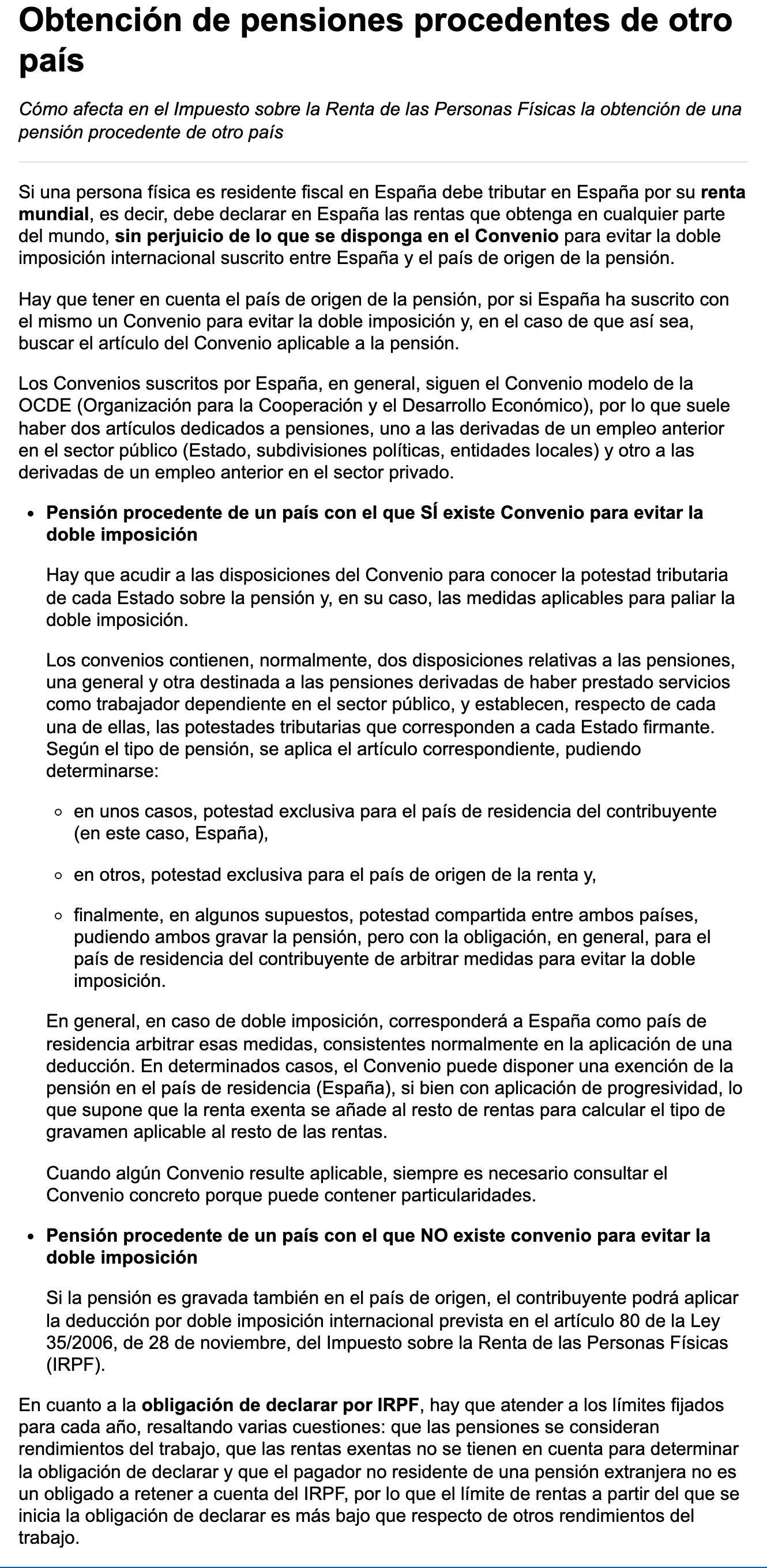
The answer depends on your pension type. Spain’s treaties generally follow the OECD model, which usually has two pension articles: one for pensions from past public-sector employment and one for pensions from past private-sector employment. Depending on the pension type, a treaty gives one of three results:
- The country of residence, Spain for you, has the exclusive right to tax.
- The country the income comes from has the exclusive right to tax.
- Taxing rights are shared, and the country of residence generally has to relieve the double taxation.
Where double taxation arises, Spain as country of residence normally relieves it with a tax deduction. In some cases a treaty exempts the pension in Spain but with progressivity: the exempt income is added to other income to work out the rate on the rest. Always check the specific treaty, because it may contain particularities.
Where there is no treaty and the pension is also taxed at the source, you may claim the international double taxation deduction in article 80 of the IRPF law. The credit equals the lower of the foreign tax actually paid and the average effective Spanish rate on the foreign-taxed part of the base.
The Tax Agency publishes the list of treaties Spain has signed; each country’s entry links to the treaty text.
United Kingdom
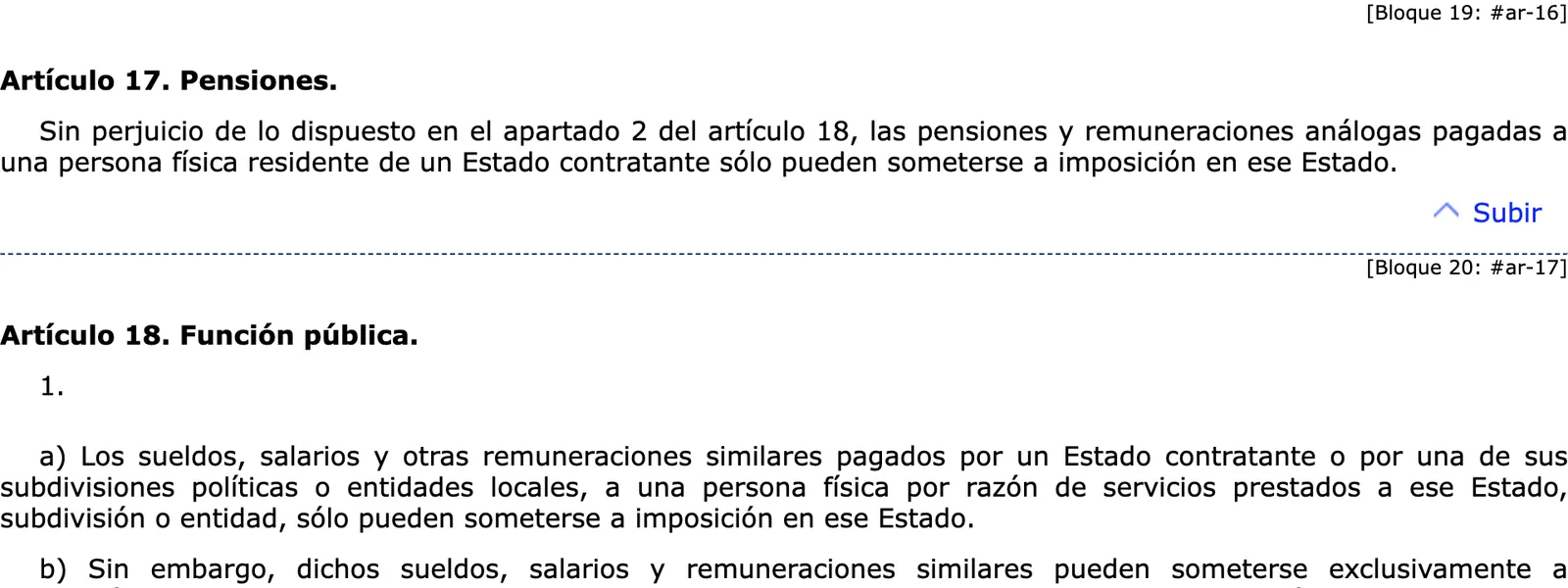
The Spain-UK treaty gives pensions paid to a resident of one state taxation only in that state, without prejudice to the government-service article.
Sin perjuicio de lo dispuesto en el apartado 2 del artículo 18, las pensiones y remuneraciones análogas pagadas a una persona física residente de un Estado contratante sólo pueden someterse a imposición en ese Estado.
Without prejudice to paragraph 2 of article 18, pensions and similar remuneration paid to an individual resident of a Contracting State may be taxed only in that State.
Convenio España-Reino Unido 2013, art. 17
Pensions paid by a state or its authorities for services to it can be taxed only in the paying state. If the person is both resident and a national of the other state, that other state taxes them exclusively.
United States
The Spain-US treaty gives a pension for past employment, obtained by a resident of one state who is its beneficial owner, taxation only in that state. Social Security benefits paid by one state to a resident of the other, or to a US citizen, may be taxed in the paying state.
The treaty also lets each state tax its residents, and lets the US tax its citizens, as if the treaty had not entered into force, with listed exceptions. A US citizen in Valencia therefore needs a US-side check as well.
For a German pension, the German pension tax guide works through it step by step.
Spanish tax scales for 2026
Two scales apply to the general taxable base: the state scale and the regional scale approved by the community. The part of the base above the personal and family minimum is taxed with each scale. Pensions are employment income, so they fall in the general base.
State scale
| Taxable base from | Tax at that point | Rate on the band |
|---|---|---|
| €0.00 | €0.00 | 9.50% |
| €12,450.00 | €1,182.75 | 12.00% |
| €20,200.00 | €2,112.75 | 15.00% |
| €35,200.00 | €4,362.75 | 18.50% |
| €60,000.00 | €8,950.75 | 22.50% |
| €300,000.00 | €62,950.75 | 24.50% |
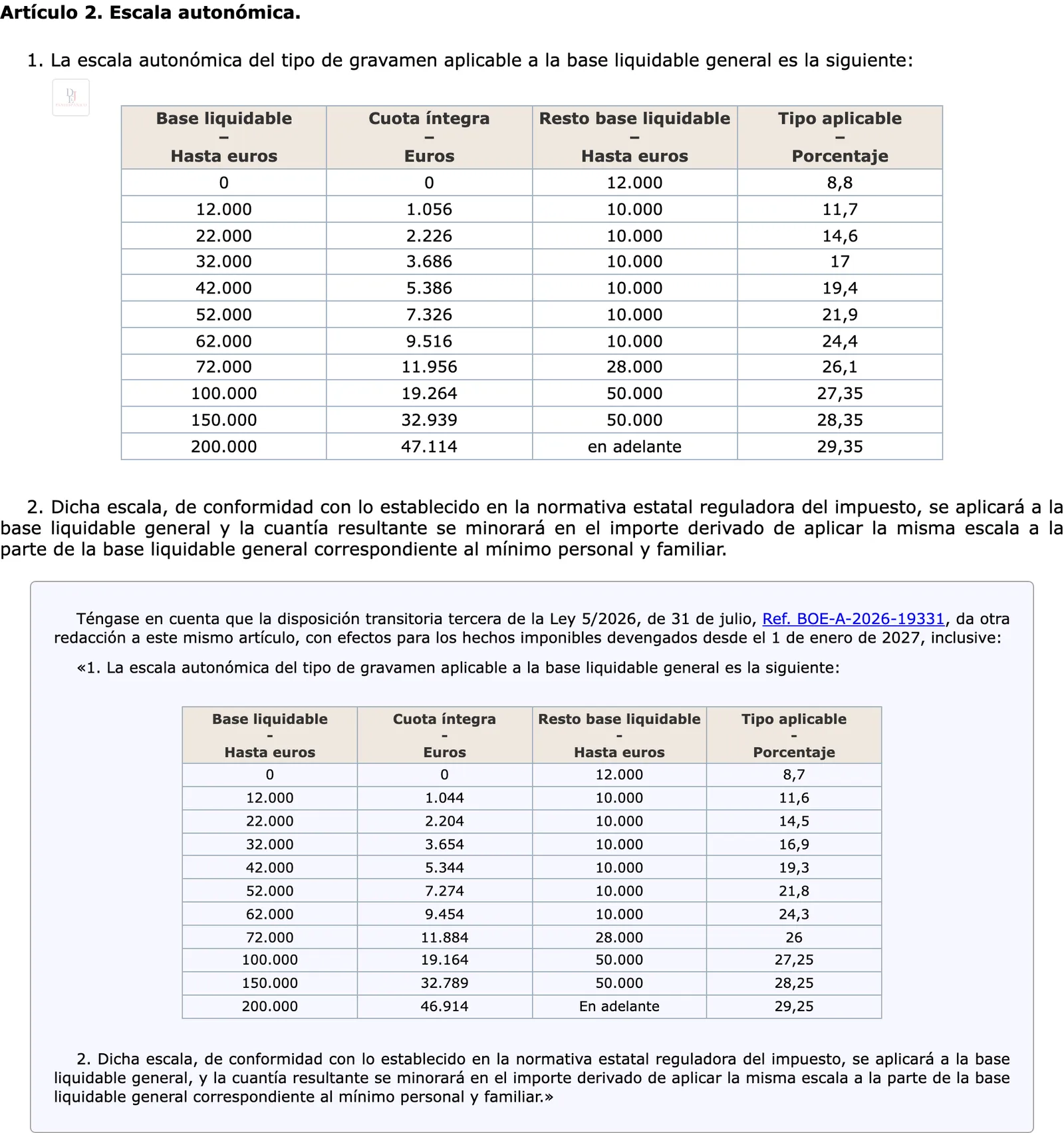
Valencian scale for 2026
| Taxable base from | Tax at that point | Rate on the band |
|---|---|---|
| 0 euros | 0 euros | 8.8% |
| €12,000 | €1,056 | 11.7% |
| €22,000 | €2,226 | 14.6% |
| €32,000 | €3,686 | 17% |
| €42,000 | €5,386 | 19.4% |
| €52,000 | €7,326 | 21.9% |
| €62,000 | €9,516 | 24.4% |
| €72,000 | €11,956 | 26.1% |
| €100,000 | €19,264 | 27.35% |
| €150,000 | €32,939 | 28.35% |
| €200,000 | €47,114 | 29.35% |
Tip: each scale gives the tax for your band as the tax at the start of the band plus the rate on the part above it. The result is then reduced by the tax the same scale would produce on the personal and family minimum.
A law of 31 July 2026 gives the Valencian article a different wording for tax events from 1 January 2027, inclusive, so re-check the scale for 2027.
Savings income
Savings income follows a separate pair of scales, state and regional.
| Savings base from | State rate | Regional rate |
|---|---|---|
| 0 euros | 9.5% | 9.5% |
| €6,000.00 | 10.5% | 10.5% |
| €50,000.00 | 11.5% | 11.5% |
| €200,000.00 | 13.5% | 13.5% |
| €300,000.00 | 15% | 15% |
The personal minimum
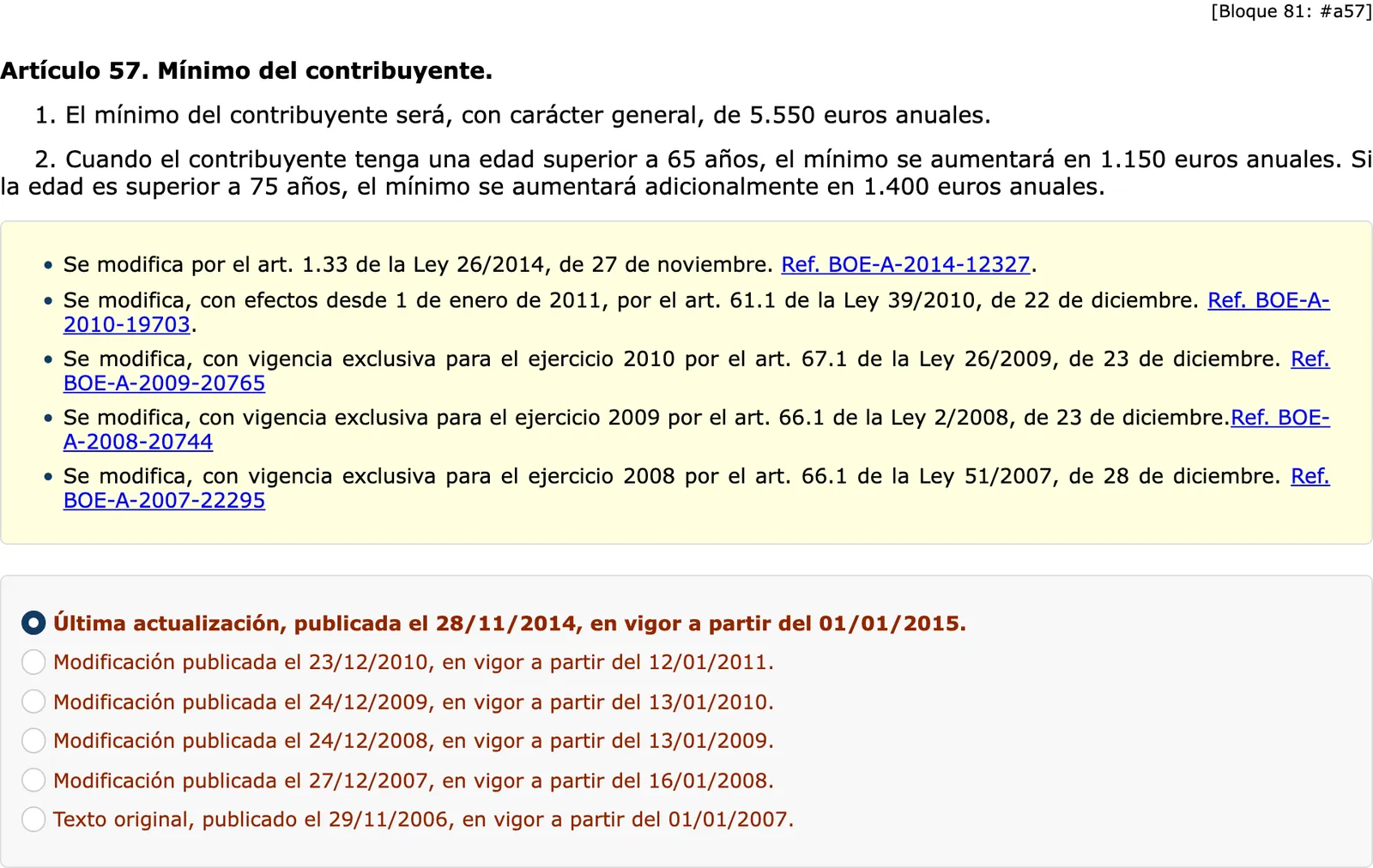
The minimum shields part of your income. The scale result is reduced by the tax the same scale would produce on the part of the base that matches the personal and family minimum.
| Minimum per year | State | Comunitat Valenciana |
|---|---|---|
| General | €5,550 | €6,105 |
| Over 65, extra | €1,150 | €1,265 |
| Over 75, further extra | €1,400 | €1,540 |
Do you have to file a return?
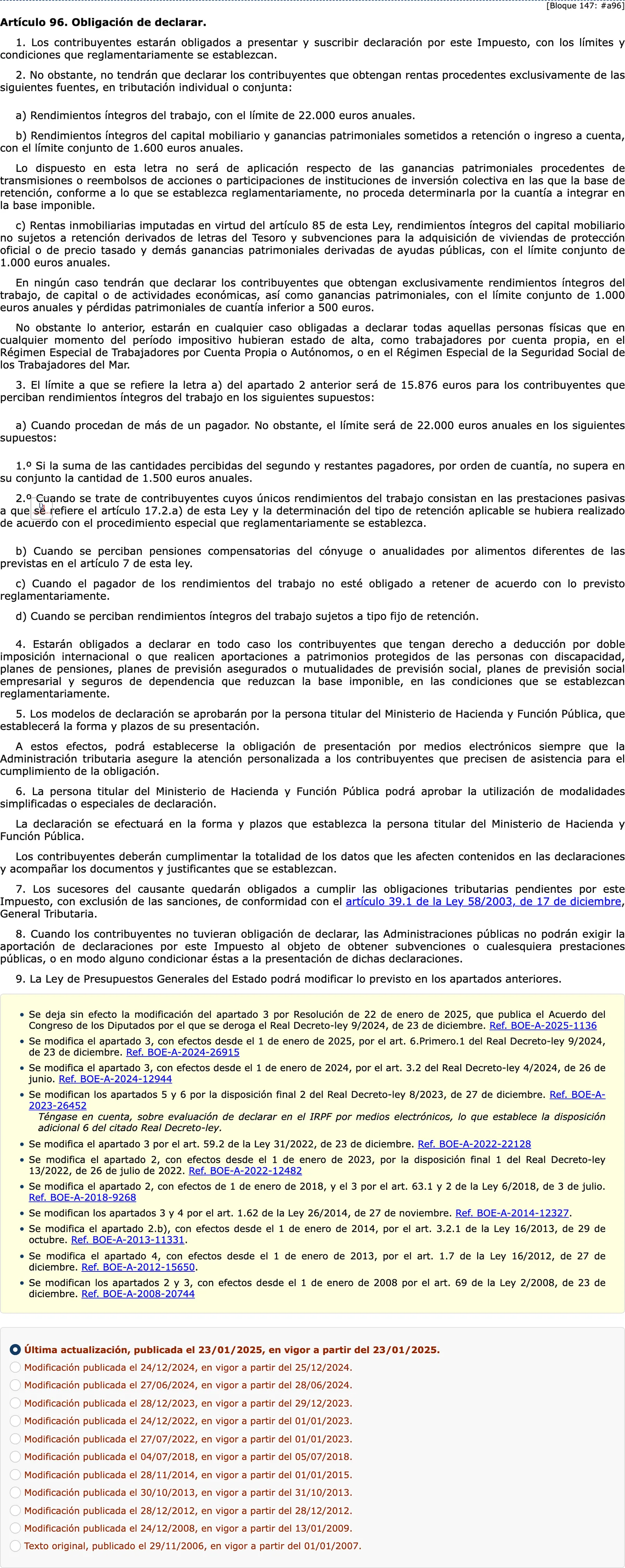
A resident whose only income is employment income, pensions included, does not have to file if it is under €22,000 a year. The limit is €15,876 when the income comes from more than one payer.
Two exceptions keep the €22,000 limit with more than one payer. The first applies when the second and later payers together paid no more than €1,500. The second applies when your only income is pensions and the withholding rate was set under the special procedure. It is also €15,876 when the payer is not obliged to withhold Spanish IRPF, as a foreign pension payer is not.
You must file in any case if you are entitled to the international double taxation deduction, or if you were registered as self-employed at any time in the tax year.
For the 2025 tax year the filing period ran from 8 April to 30 June 2026, inclusive, whatever the result. The Wealth Tax return had the same window. Check the Tax Agency page each spring for the next window.
Do you report assets abroad?
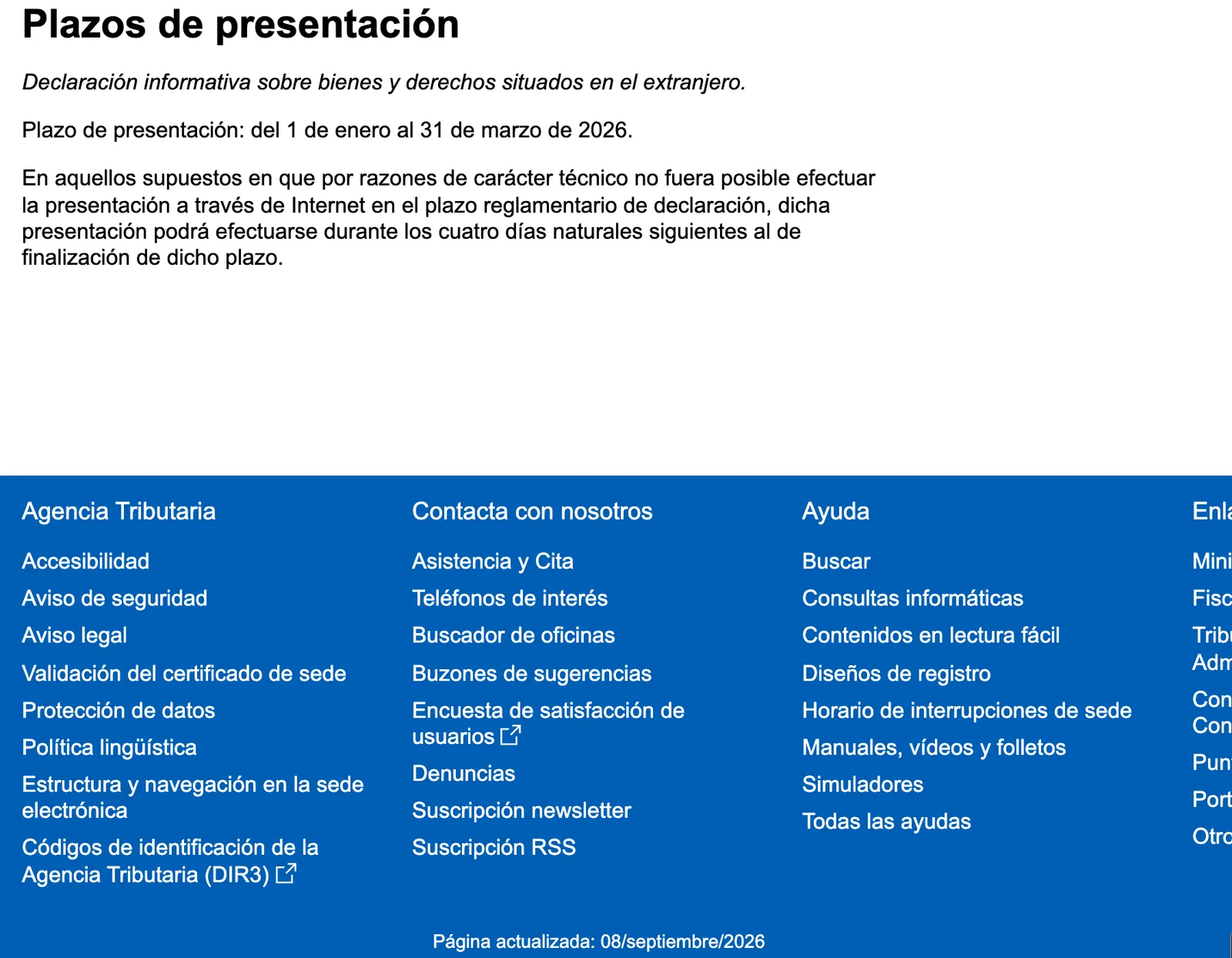
Residents report accounts held abroad. There is no duty when the combined 31 December balances do not exceed €50,000 and the last-quarter average also stays below it. Foreign securities and funds follow the same €50,000 test, as does foreign real estate. The return is due between 1 January and 31 March of the following year.
Read the foreign-assets guide and the bank account guide for the practical side. If your pension comes from more than one country, or sits close to a treaty or filing limit, a gestor is worth booking.
Photo credits
- The Turia gardens, the long park along the old river bed in Valencia: Dorieo, Wikimedia Commons (opens in a new tab) (CC BY-SA 4.0)
Step by step
- Work out whether you will be tax residentMore than 183 days in Spain in the calendar year, or your main base of economic interests here.
- Read your treaty's pension articleFind your country on the Tax Agency treaty list; check which state taxes your type of pension.
- Apply the Spanish scalesThe state scale and the Valencian scale are applied to the general taxable base, after the personal minimum.
- Test the filing limitsPension-only income below €22,000 needs no return; the limit is €15,876 for a payer not obliged to withhold.
- Report foreign assets above the limitAccounts, securities and property abroad above €50,000 are reported.
Not confirmed: Treaties other than the UK and US: the treaty text on the Tax Agency list decides, so read your country's pension article or ask a gestor. Wealth Tax and inheritance tax are not covered here, and the Valencian scale changes from 2027.
Reach readers planning life in Valencia. Advertise → hello@settlevalencia.com
Common questions
Do I pay tax in Spain on my pension?
Yes, if you are a tax resident. A tax resident of Spain is taxed on worldwide income, subject to any double taxation treaty. Pensions count as employment income. You are resident if you stay more than 183 days in the calendar year or your main base of economic interests is in Spain.
Is my UK pension taxed in Spain?
Generally in Spain once you are resident. Under the Spain-UK treaty, pensions paid to a resident of one state are taxed only in that state. Pensions paid by a state for government service follow a separate article that points to the paying state. Read the treaty text for your pension type.
Is my US pension or Social Security taxed in Spain?
Under the Spain-US treaty, a pension for past employment is taxed only in the state where the beneficial owner resides. US Social Security benefits may be taxed by the US. The US may also tax its citizens as if the treaty did not exist. Ask an asesor fiscal for the credit mechanics.
What tax rates will I pay in Valencia?
Two scales apply to the general taxable base: the state scale and the Comunitat Valenciana scale. The state scale runs from 9.50% to 24.50%. The Valencian scale for 2026 runs from 8.8% to 29.35%.
Do I have to file a return if I am retired?
Below the limit, no. People whose only income is employment income, pensions included, need not file below €22,000 a year. The limit is €15,876 when the payer is not obliged to withhold, as with a foreign pension payer. Self-employed registration or the double-tax deduction always requires a return.
Does the Valencian scale change next year?
Yes, the wording changes. A law of 31 July 2026 gives article 2 of the Valencian regional law a different wording for tax events from 1 January 2027. The figures here are the 2026 scale. Re-check the scale for 2027.
Can I use the Beckham regime as a retiree?
Yes, if the move to Spain results from a listed circumstance: an employment contract, becoming a company director, entrepreneurial activity or work as a highly qualified professional. Ask a gestor whether your case fits that list.
Do I report the accounts and assets I keep abroad?
Not below the limit. There is no duty to report foreign accounts when the combined 31 December balances do not exceed €50,000 and the last-quarter average also stays below it. The same €50,000 limit applies to foreign securities and real estate.
Read next
General information checked against the sources listed above, not legal advice for your situation. Rules and office practice change; confirm with the immigration office or a licensed adviser before you act. See how guides are checked.
Spotted an error? Report it.